


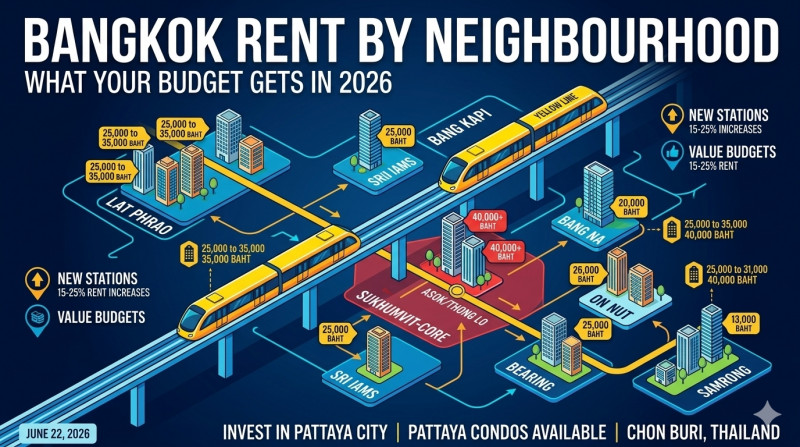
Moving past the "Sukhumvit-only" mindset—a complete data-driven breakdown of rental costs, transit corridors, and upfront fees for expats moving to Bangkok in 2026.
Most pre-arrival expats default to Sukhumvit when looking for a home simply because it is the only Bangkok neighborhood they can name. There is a common assumption that stepping outside this core means settling for a worse apartment.
However, treated as a single destination, this 15-kilometer corridor causes massive budget confusion. Bangkok’s expat rental market actually organizes itself around distinct tiers of the BTS Sukhumvit Line and newly expanding transit mass lines.
Whether you are looking to rent in Bangkok or considering a coastal pivot to a Pattaya Condo Rental, understanding the real numbers behind the 2026 market will completely change your property hunt.
1. Demystifying the Sukhumvit Line Tiers
The spread across the different segments of the Sukhumvit corridor sits at roughly 50%. To find the right home, you have to look at the line in three clear tiers:
Lower Sukhumvit: Nana and Asok
This is the ultimate convenience hub where most new arrivals start their search. Asok serves as Bangkok’s most critical transit node with a direct BTS and MRT interchange via a short, covered walkway.
- Studios: 14,000 to 20,000 Baht/month
- One-Bedrooms: 18,000 to 28,000 Baht/month
- Two-Bedrooms: 35,000 to 55,000 Baht/month
The Trade-off: Exceptional retail density with Terminal 21 sitting directly above the station, but high noise, foot traffic, and extreme congestion during peak hours.
Mid Sukhumvit: Phrom Phong, Thong Lo, and Ekkamai
This cluster is what most expats picture when they envision high-end Bangkok living.
- Phrom Phong & Thong Lo: Studios cost 16,000 to 24,000 Baht; one-bedrooms run 22,000 to 35,000 Baht; and premium stock pushes well past 35,000 Baht for a single bedroom. Two-bedrooms range from 45,000 to 80,000 Baht.
- Ekkamai: A slightly more forgiving tier. Studios go for 12,000 to 18,000 Baht; one-bedrooms for 15,000 to 22,000 Baht; and two-bedrooms for 35,000 to 55,000 Baht.
Note on Market Trends: Lease renewals across the Mid Sukhumvit tier typically carry a 5% uplift with each cycle.
Upper Sukhumvit: Phra Khanong, On Nut, and Bang Chak
This is where the true "value argument" lives. The building stock here has largely caught up in quality to Thong Lo, but the prices haven't followed. On Nut has officially become the default reference point for expats wanting a great condo without a prestigious price tag.
| Area | Studio | One-Bedroom | Two-Bedroom |
| Phra Khanong | 10,000 – 16,000 Baht | 14,000 – 22,000 Baht | 28,000 – 40,000 Baht |
| On Nut | 10,000 – 15,000 Baht | 15,000 – 25,000 Baht | 28,000 – 42,000 Baht |
| Bang Chak | 8,000 – 14,000 Baht | 12,000 – 18,000 Baht | 22,000 – 32,000 Baht |
2. Alternatives to the Core: Silom, Sathorn, and Bang Na
If Sukhumvit doesn't fit your daily routine, Bangkok offers two other major expat strongholds with completely different advantages:
Silom and Sathorn (The Central Business District)
Often overlooked by beach-seeking expats, the transit coverage here is stronger than anywhere else on the Sukhumvit Line. You get four transit access points within the same walkable radius: BTS Sala Daeng, BTS Chong Nonsi, MRT Lumpini, and MRT Silom.
- Price Points: Studios cost 16,000 to 24,000 Baht; one-bedrooms run 25,000 to 35,000 Baht in standard buildings (upwards of 40,000 to 55,000 Baht in premium projects); and two-bedrooms hit 50,000 to 70,000 Baht.
- The Benefit: While the one-bedroom range overlaps with Thong Lo, the same budget in Silom/Sathorn frequently secures significantly more floor space and four transit lines instead of just one.
Bang Na (The International School Corridor)
Bang Na is about as far out as most expats will seriously consider. While rents are on the lower end and walkability to mass transit is weaker, it is highly sought after by families.
- Price Points: Studios cost 8,000 to 14,000 Baht; one-bedrooms run 10,000 to 18,000 Baht; and two-bedrooms run 18,000 to 30,000 Baht.
- The Draw: The combination of expansive living space and immediate proximity to the elite international school corridor running south toward Bearing completely outweighs transit drawbacks for families.
3. The 2026 Transit Loophole: Yellow and Pink Lines
Massive infrastructure additions have altered the rental landscape outside the city center.
The Yellow Line, which runs 30 kilometers from Lat Phrao to Samrong across 23 stations, completely changed the rental calculations on Bangkok’s eastern fringe. While rents near these new stations jumped 15% to 25% within the first couple of years, they remain well below Sukhumvit equivalents for comparable building quality. For example, at a 25,000 to 35,000 Baht budget, choosing the Yellow Line area gets you a two-bedroom property compared to just a one-bedroom in On Nut, even though both connect to the same core network.
Additionally, the Pink Line’s Muang Thong Thani spur entered full commercial service in June 2025, opening up a northern fringe corridor on similar budget-friendly terms.
4. How to Narrow Down Your Choice Before Signing
When making the final call on a neighborhood, look beyond the raw pricing data and weigh these two variables:
- The 700-Meter Rule: Across almost every neighborhood, a condo located 600 to 900 meters from the nearest BTS or MRT station typically costs 20% to 40% less than a comparable building within 500 meters. If you work from home or rely on ride-hailing apps, taking that 10-to-14-minute walk will save you thousands of Baht a month.
- The Daily Reality Check: Long-term expats agree that daily life quickly consolidates around your immediate BTS stop and the nearest supermarket. Ask yourself how much you will realistically travel into the mid-corridor restaurant scenes before paying a premium to live right next to them.
5. What You Need on Day One (Upfront Costs)
Before collecting your keys, remember that Bangkok's standard rental terms require a three-month upfront cash outlay regardless of the neighborhood:
- One month's advance rent
- Two months' security deposit
- A Note on Consumer Protection Laws: While Thai consumer protection regulations legally cap the security deposit at one month for landlords who own five or more properties, the vast majority of individual condo landlords own fewer and fall outside this threshold.
Therefore, a 25,000 Baht/month condo will require 75,000 Baht upfront, while a 35,000 Baht/month condo requires 105,000 Baht. By law, your deposit must be returned within five days of your post-lease inspection, and landlords are strictly prohibited from deducting cash for normal wear and tear.
Looking for Coastal Value Instead?
If these city prices have you rethinking urban life, many expats choose to look an hour and a half down the coast. Discover how far your currency stretches by reading our comprehensive Pattaya Real Estate Market Guide or check the official Thai Immigration Bureau portal to ensure your long-term visa supports your lease structure perfectly.
Contact the ROOF21 Team today to find your perfect Thai rental!


