


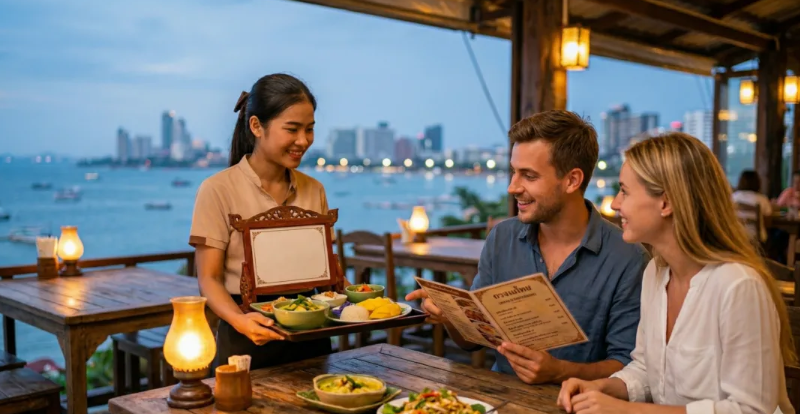
The most common Thai phrases that will open doors and hearts for you in Thailand
Thailand is not known as the “Land of Smiles” for nothing. The locals are incredibly friendly, hospitable, and always willing to help. While you’ll have no trouble communicating in English in popular destinations like Phuket, Pattaya, and Koh Samui, knowing a few basic Thai words can do wonders.
Whether you're in Thailand on a short vacation or coming here to check out your new dream apartment or villa , if you speak a little Thai, the locals will immediately appreciate it and reward you with an even wider smile.
We have prepared a list of the most important phrases for you to use in Thailand.
Golden rule: "Khrap" and "Kha"
Before we get into the phrases themselves, it's important to understand one basic pillar of Thai politeness. A word is added to the end of a sentence to express respect and politeness. Interestingly, this word changes according to the gender of the speaker , not the person being addressed:
- If you are a man: You add the word Khrap (often pronounced abbreviated as Krap ) to the end of the sentence .
- If you are a woman: You add the word Kha to the end of the sentence .
Example: When a man wants to say thank you, he says “Khop khun khrap ”. A woman says “Khop khun kha ”.
1. Greetings and basics of politeness
You will use these phrases every day, from arriving at the reception to meeting with the broker.
- Sawasdee (Savatdí) – Good morning / Hi / Goodbye This is a universal greeting. It often involves the hands being joined together in prayer at chest height, which is called a Wai .
- Khop khun (Kop kun) – Thank you. A basic word that will open any door.
- Khor thot – Excuse me / With permission Used when you step on someone's foot, need to get through a crowd, or want to address someone politely.
- Mai pen rai (Maj pen rai) – It’s nothing / No problem / It’s fine This is not just a phrase, but a literal Thai philosophy of life. If something goes wrong, the bus is late or they bring you bad food, with a smile and “Mai pen rai” everything will be resolved peacefully.
2. Useful words for shopping and restaurants
Whether you're haggling at a night market or ordering Pad Thai, this is what you need:
- Tao rai? (Tao rai?) – How much does it cost? Ideal for markets. If the price seems too high, you can try to negotiate with a smile.
- Chai / Mai chai (Chai / Mai chai) – Yes / No
- Ao / Mai ao (Ao / Mai ao) – I want / I don't want If they offer you goods on the street that you don't want, just say "Mai ao, khrap/kha" (I don't want, thank you) with a smile.
- A-roi (Aroj) – Delicious / Delicious Tell this to the chef at a restaurant and see the joy!
- Mai pet (Maj phet) – Not spicy A very important phrase! Thai food can be extremely hot for a European. If you can't stand chili, be sure to remember "Mai phet".
3. When Thai is not enough
Sometimes you will find yourself in a situation where you need to switch to English.
- Phut phasa angkrit dai mai? (Put phasa angkrit dai mai?) – Do you speak English?
- Kao chai / Mai kao chai (Khao jai / Mai khao jai) – I understand / I don't understand
- Hong nam yoo tee nai? (Hong nam you tí nai?) – Where is the toilet?
Start with little, you will gain a lot
Thai is a tonal language, which means that intonation changes the meaning of a word. This may sound intimidating to us, but the locals don't expect you to have perfect pronunciation. They appreciate the effort itself.
When you arrive in Thailand, try your first Sawatdee right at the airport. You might like this country so much that you want to spend more time here. And if that happens, don't forget that we at ROOF21 are always happy to help you find the perfect home, in Thailand.
Chok dee (Good luck)!


